

Report
News and reports
Our August 2025 E-Bulletin is now available
A brief outline of some of the issues and themes patients have faced when accessing Walsall Services during August 2025.
Report

Our latest Enter and View Report for Birchills Health Centre is now avialble
To read or download a copy.
Report
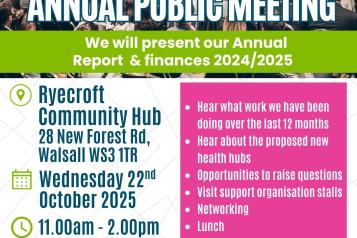
It's Our Annual Public Meeting and you are invited!
We will present our Annual Public Report 2024/2025.
There will be a special presentation around 'Neighbourhood Hubs'. What are they? You ask. Then join us on the day and find out!
There will be support organisations available for you to access support or valuable information, and advice.
There will be a special presentation around 'Neighbourhood Hubs'. What are they? You ask. Then join us on the day and find out!
There will be support organisations available for you to access support or valuable information, and advice.
News
NHS launches winter vaccination programme
Eligible people living in Birmingham, the Black Country and Solihull are being invited to come forward for a flu and COVID-19 vaccine.
The vaccination programmes started on 1 September, when flu vaccines became available for young children (aged 2 and 3), pregnant women, school-aged children.
From 1 October, the COVID-19 and flu vaccination programme will extend to adults aged 65 and 0ver, people in clinical risk groups, carers, frontline health and social care staff, and those living in care homes.
Local health leaders are working to increase uptake following a national decline in vaccination rates. Both ICBs are working closely with GPs, community pharmacies, schools, local authorities, and voluntary organisations to make vaccinations as accessible as possible. Where possible, people will be offered both vaccines at the same time for convenience and maximum protection ahead of winter.
Helen Kelly, Chief Nurse for Birmingham and Solihull ICB, said: “Vaccines remain our best protection against flu, COVID-19 and other seasonal illnesses. We know uptake has fallen in recent years, but this makes it even more important that those eligible take up the offer this autumn. By getting vaccinated in September or October, you’ll be protecting yourself and those around you through the winter months.”
Dr Sally Roberts, Chief Nurse for the Black Country ICB, added: “Flu and COVID-19 are still serious illnesses that can lead to hospitalisation, especially for older people, those with long-term conditions, and pregnant women. We want to make it as easy as possible for people to get protected, whether that’s at their GP, a pharmacy, a school clinic, or a specially arranged community session.”
Alongside flu and COVID, eligible patients can also get their Respiratory Syncytial Virus (RSV) vaccination at their local GP practice or at participating pharmacies, across Birmingham and the Black Country. This immunisation is available for those aged 75 to 79 or pregnant women over 28 weeks.
Pneumococcal vaccines are also available for anyone aged 65 and over via GP practices.
Those eligible for COVID and flu immunisations are able to book an appointment via the National
Booking System. Appointments are also be available on the NHS App or by calling 119. Calls to 119 are free from mobiles and landlines and the booking service provides support in 200 different languages.
Those who have difficulties communicating or hearing, or are a BSL user can use textphone 18001
or the NHS 119 British Sign Language (BSL) interpreter service.
Both ICBs are encouraging local people to take up their invite as soon as they receive it.
The vaccination programmes started on 1 September, when flu vaccines became available for young children (aged 2 and 3), pregnant women, school-aged children.
From 1 October, the COVID-19 and flu vaccination programme will extend to adults aged 65 and 0ver, people in clinical risk groups, carers, frontline health and social care staff, and those living in care homes.
Local health leaders are working to increase uptake following a national decline in vaccination rates. Both ICBs are working closely with GPs, community pharmacies, schools, local authorities, and voluntary organisations to make vaccinations as accessible as possible. Where possible, people will be offered both vaccines at the same time for convenience and maximum protection ahead of winter.
Helen Kelly, Chief Nurse for Birmingham and Solihull ICB, said: “Vaccines remain our best protection against flu, COVID-19 and other seasonal illnesses. We know uptake has fallen in recent years, but this makes it even more important that those eligible take up the offer this autumn. By getting vaccinated in September or October, you’ll be protecting yourself and those around you through the winter months.”
Dr Sally Roberts, Chief Nurse for the Black Country ICB, added: “Flu and COVID-19 are still serious illnesses that can lead to hospitalisation, especially for older people, those with long-term conditions, and pregnant women. We want to make it as easy as possible for people to get protected, whether that’s at their GP, a pharmacy, a school clinic, or a specially arranged community session.”
Alongside flu and COVID, eligible patients can also get their Respiratory Syncytial Virus (RSV) vaccination at their local GP practice or at participating pharmacies, across Birmingham and the Black Country. This immunisation is available for those aged 75 to 79 or pregnant women over 28 weeks.
Pneumococcal vaccines are also available for anyone aged 65 and over via GP practices.
Those eligible for COVID and flu immunisations are able to book an appointment via the National
Booking System. Appointments are also be available on the NHS App or by calling 119. Calls to 119 are free from mobiles and landlines and the booking service provides support in 200 different languages.
Those who have difficulties communicating or hearing, or are a BSL user can use textphone 18001
or the NHS 119 British Sign Language (BSL) interpreter service.
Both ICBs are encouraging local people to take up their invite as soon as they receive it.
Advice and Information

Our July 2025 E-Bulletin is now available
A brief outline of some of the issues and themes patients have faced when accessing Walsall Services during July 2025.
Report
Get the right care over the August bank holiday
Ahead of the summer bank holiday (Monday 25 August), people in the Black Country are being reminded how to access NHS health services.
Due to the bank holiday some services such as GP surgeries and pharmacies may be closed or working on a reduced service. Selected pharmacies will still be available for prescriptions, nonurgent medical advice, and treatment of common ailments.
People who need medical help that isn’t an emergency should contact NHS 111 in the first instance by visiting 111.nhs.uk or by calling 111.
NHS 111 can help direct people to the most appropriate local health service if they aren’t sure where to go – this could include an out of hours GP, a pharmacy, a local NHS walk-in centre, or a hospital accident & emergency (A&E) department.
Dr Ananta Dave, Chief Medical Officer for the NHS Black Country Integrated Care Board, said: “We know that sometimes people can feel unsure about where to go for help if they become unwell over a bank holiday weekend.
“A number of pharmacies will remain open over the bank holiday weekend and should be your first port of call for any minor health concerns. Pharmacists are able to offer clinical advice and can now supply medicines for a number of conditions, without the need for a GP appointment or prescription.
“If you need urgent medical help over the long weekend, contact NHS 111 in the first instance and they will direct you to the most appropriate service for advice or treatment.
“While we hope that everyone enjoys the long weekend, if you’re feeling unwell it’s vital that you seek appropriate help. The NHS continues to be here for you so please don’t hesitate to come forward.”
A&E departments and 999 are there to treat the most serious and life-threatening conditions. If you are feeling unwell and it is not an emergency, contact NHS 111.
Due to the bank holiday some services such as GP surgeries and pharmacies may be closed or working on a reduced service. Selected pharmacies will still be available for prescriptions, nonurgent medical advice, and treatment of common ailments.
People who need medical help that isn’t an emergency should contact NHS 111 in the first instance by visiting 111.nhs.uk or by calling 111.
NHS 111 can help direct people to the most appropriate local health service if they aren’t sure where to go – this could include an out of hours GP, a pharmacy, a local NHS walk-in centre, or a hospital accident & emergency (A&E) department.
Dr Ananta Dave, Chief Medical Officer for the NHS Black Country Integrated Care Board, said: “We know that sometimes people can feel unsure about where to go for help if they become unwell over a bank holiday weekend.
“A number of pharmacies will remain open over the bank holiday weekend and should be your first port of call for any minor health concerns. Pharmacists are able to offer clinical advice and can now supply medicines for a number of conditions, without the need for a GP appointment or prescription.
“If you need urgent medical help over the long weekend, contact NHS 111 in the first instance and they will direct you to the most appropriate service for advice or treatment.
“While we hope that everyone enjoys the long weekend, if you’re feeling unwell it’s vital that you seek appropriate help. The NHS continues to be here for you so please don’t hesitate to come forward.”
A&E departments and 999 are there to treat the most serious and life-threatening conditions. If you are feeling unwell and it is not an emergency, contact NHS 111.
Advice and Information
Heat health alert issued for the Black Country
The NHS in the Black Country has issued important guidance as temperatures climb this
week.
The Met Office, in conjunction with the UK Health Security Agency (UKHSA), has issued an amber heat alert as temperatures are set to rise this week, with people advised to take extra care in the heatwave conditions.
Over the next few days temperatures across the Black Country are predicted to reach up to 30 degrees Celsius, with the amber alert in place from Tuesday 12 August to Wednesday 13 August.
Sally Roberts, Chief Nursing Officer for the NHS Black Country Integrated Care Board (ICB), said: “While many of us enjoy the sunshine and warmer weather, high temperatures can pose serious health risks, especially for older adults, young children, and people with existing health conditions. These groups are less able to regulate body temperature and are more vulnerable tooverheating, heat exhaustion, and even heatstroke.
“It’s also important we look out for one another. Check in on elderly neighbours, friends, or family members who may need extra support during periods of prolonged heat. A small act of kindness can go a long way.
“By taking these simple steps, we can help ensure that everyone stays safe, comfortable, and well during the warmer months.”
“Many of these heat-related illnesses are preventable with a few simple precautions. Try to stay indoors during the hottest part of the day, usually between 11am and 3pm. Keep hydrated by drinking plenty of cool fluids, avoid sunburn by applying sunscreen regularly, and seek shade whenever possible. If you need to go out, take water with you and wear light, loose-fitting clothing. At home, keep indoor spaces cool by closing blinds or curtains in sun-facing rooms.
If you, or others, start to feel unwell, move out of the heat immediately and drink some water to If you, or others, start to feel unwell, move out of the heat immediately and drink some water to rehydrate. If you feel dizzy, weak, or have a headache and intense thirst, visit NHS 111 online or call 111 for more advice.
rehydrate. If you feel dizzy, weak, or have a headache and intense thirst, visit NHS 111 online or call 111 for more advice.
week.
The Met Office, in conjunction with the UK Health Security Agency (UKHSA), has issued an amber heat alert as temperatures are set to rise this week, with people advised to take extra care in the heatwave conditions.
Over the next few days temperatures across the Black Country are predicted to reach up to 30 degrees Celsius, with the amber alert in place from Tuesday 12 August to Wednesday 13 August.
Sally Roberts, Chief Nursing Officer for the NHS Black Country Integrated Care Board (ICB), said: “While many of us enjoy the sunshine and warmer weather, high temperatures can pose serious health risks, especially for older adults, young children, and people with existing health conditions. These groups are less able to regulate body temperature and are more vulnerable tooverheating, heat exhaustion, and even heatstroke.
“It’s also important we look out for one another. Check in on elderly neighbours, friends, or family members who may need extra support during periods of prolonged heat. A small act of kindness can go a long way.
“By taking these simple steps, we can help ensure that everyone stays safe, comfortable, and well during the warmer months.”
“Many of these heat-related illnesses are preventable with a few simple precautions. Try to stay indoors during the hottest part of the day, usually between 11am and 3pm. Keep hydrated by drinking plenty of cool fluids, avoid sunburn by applying sunscreen regularly, and seek shade whenever possible. If you need to go out, take water with you and wear light, loose-fitting clothing. At home, keep indoor spaces cool by closing blinds or curtains in sun-facing rooms.
If you, or others, start to feel unwell, move out of the heat immediately and drink some water to If you, or others, start to feel unwell, move out of the heat immediately and drink some water to rehydrate. If you feel dizzy, weak, or have a headache and intense thirst, visit NHS 111 online or call 111 for more advice.
rehydrate. If you feel dizzy, weak, or have a headache and intense thirst, visit NHS 111 online or call 111 for more advice.
Advice and Information
Order repeat prescriptions ahead of the August bank holiday
People in the Black Country are being reminded to order any repeat prescriptions they may need ahead of the summer bank holiday (Monday 25 August).
GP practices and pharmacies will have limited opening hours over the bank holiday weekend, making it more challenging for people to access medicines at short notice and may lead to a delay in getting your medication.
Every bank holiday, NHS 111 sees an increase in people getting in touch regarding repeat prescriptions. Waiting and using emergency or urgent services over the bank holiday puts added pressure on already busy services.
To avoid this and to ensure your health is not put at any unnecessary risk, people who take regular prescription medication are being asked to submit any repeat prescriptions that are due for renewal by Friday 14 August to make sure there is enough time for them to be processed and dispensed.
Dr Ananta Dave, Chief Medical Officer for the NHS Black Country Integrated Care Board, said: “We want everyone to enjoy a safe and healthy bank holiday weekend. Running out of your usual medication can be a huge worry and have serious consequences, so it’s important to plan and order any prescriptions you may need over the long weekend.
“The easiest way to order repeat prescriptions is via the NHS App or through your GP practice website. If you do not have access to GP online services, you can phone your GP practice to order prescriptions.
“Bank holiday weekends are always busy times for the NHS, so ordering and picking up a repeat prescription in advance really does help us, help you.”
Most repeat medication requests can be made online, via local practice websites or through the NHS App. People who do not use the internet can approach their practice to access their prescriptions.
If people feel unwell over the bank holiday weekend, but it’s not life threatening, they can contact NHS 111 online at 111.nhs.uk or by calling 111. NHS 111 can help direct people to the most appropriate local health service if they aren’t sure where to go – this could include an out of hours GP, a pharmacy, a local NHS walk-in centre, or a hospital accident & emergency (A&E) department.
Urgent and emergency care services will also be open as normal over the long weekend. People should only call 999 or attend A&E services in the event of an emergency.
GP practices and pharmacies will have limited opening hours over the bank holiday weekend, making it more challenging for people to access medicines at short notice and may lead to a delay in getting your medication.
Every bank holiday, NHS 111 sees an increase in people getting in touch regarding repeat prescriptions. Waiting and using emergency or urgent services over the bank holiday puts added pressure on already busy services.
To avoid this and to ensure your health is not put at any unnecessary risk, people who take regular prescription medication are being asked to submit any repeat prescriptions that are due for renewal by Friday 14 August to make sure there is enough time for them to be processed and dispensed.
Dr Ananta Dave, Chief Medical Officer for the NHS Black Country Integrated Care Board, said: “We want everyone to enjoy a safe and healthy bank holiday weekend. Running out of your usual medication can be a huge worry and have serious consequences, so it’s important to plan and order any prescriptions you may need over the long weekend.
“The easiest way to order repeat prescriptions is via the NHS App or through your GP practice website. If you do not have access to GP online services, you can phone your GP practice to order prescriptions.
“Bank holiday weekends are always busy times for the NHS, so ordering and picking up a repeat prescription in advance really does help us, help you.”
Most repeat medication requests can be made online, via local practice websites or through the NHS App. People who do not use the internet can approach their practice to access their prescriptions.
If people feel unwell over the bank holiday weekend, but it’s not life threatening, they can contact NHS 111 online at 111.nhs.uk or by calling 111. NHS 111 can help direct people to the most appropriate local health service if they aren’t sure where to go – this could include an out of hours GP, a pharmacy, a local NHS walk-in centre, or a hospital accident & emergency (A&E) department.
Urgent and emergency care services will also be open as normal over the long weekend. People should only call 999 or attend A&E services in the event of an emergency.
Advice and Information

Our latest Enter and View report on Portland Medical Practice is now available.
To read or download a copy.
Report
Useful advice ahead of the planned resident doctor industrial action
People in the Black Country are being encouraged to think carefully about which NHS service they use during the upcoming industrial action.
Resident doctors, formerly known as junior doctors, are planning to strike for five consecutive days, starting from 7am on Friday 25 July until 7am on Wednesday 30 July.
Health and care partners across the Black Country are working together to prepare for the industrial action and are asking local people to support by choosing the right service for their health needs.
Anyone who needs urgent care should use NHS 111 online or call NHS 111 to be assessed and
directed to the right service. In life-threatening emergencies, people should call 999 or go to
A&E as normal.
Services such as pharmacies, GP practices, walk-in centres, minor injury units, and urgent treatment centres will remain open during the industrial action and can support people with a wide range of health concerns.
Patients with hospital appointments should attend as planned unless contacted directly by the NHS to reschedule. There is no need to call to check if your appointment is going ahead.
Dr Ananta Dave, Chief Medical Officer for the NHS Black Country Integrated Care Board, said: “During the upcoming industrial action, our priority is to continue providing safe care for those who need it. However, it’s vital that people use services wisely so that care remains available for those who need it most.
“If you need medical help or advice, please use NHS 111 online in the first instance. They will direct you to the most appropriate service, which could include your local pharmacy, GP practice, or a walk-in centre. 999 and A&E should only be used in life-threatening emergencies.”
GP practices will continue to be open as normal during the industrial action. Please continue to attend your GP and dental appointments unless you are contacted and told otherwise. Dr Julian Hobbs, Medical Director at Dudley Group NHS Foundation Trust, said: “As we prepare for the upcoming strike action, we are urging the public to use NHS services responsibly.
Please keep A&E and 999 for genuine, life-threatening emergencies so that we can prioritise care for those who need it most.
“Our top priority remains ensuring that patients in the greatest need continue to receive safe, high-quality care. Our immediate focus will be on maintaining urgent and emergency services throughout the industrial action.
“We are extremely grateful to the public for their continued support and would like to thank our dedicated NHS staff, who are working tirelessly to keep essential services running during this challenging time.”
Resident doctors, formerly known as junior doctors, are planning to strike for five consecutive days, starting from 7am on Friday 25 July until 7am on Wednesday 30 July.
Health and care partners across the Black Country are working together to prepare for the industrial action and are asking local people to support by choosing the right service for their health needs.
Anyone who needs urgent care should use NHS 111 online or call NHS 111 to be assessed and
directed to the right service. In life-threatening emergencies, people should call 999 or go to
A&E as normal.
Services such as pharmacies, GP practices, walk-in centres, minor injury units, and urgent treatment centres will remain open during the industrial action and can support people with a wide range of health concerns.
Patients with hospital appointments should attend as planned unless contacted directly by the NHS to reschedule. There is no need to call to check if your appointment is going ahead.
Dr Ananta Dave, Chief Medical Officer for the NHS Black Country Integrated Care Board, said: “During the upcoming industrial action, our priority is to continue providing safe care for those who need it. However, it’s vital that people use services wisely so that care remains available for those who need it most.
“If you need medical help or advice, please use NHS 111 online in the first instance. They will direct you to the most appropriate service, which could include your local pharmacy, GP practice, or a walk-in centre. 999 and A&E should only be used in life-threatening emergencies.”
GP practices will continue to be open as normal during the industrial action. Please continue to attend your GP and dental appointments unless you are contacted and told otherwise. Dr Julian Hobbs, Medical Director at Dudley Group NHS Foundation Trust, said: “As we prepare for the upcoming strike action, we are urging the public to use NHS services responsibly.
Please keep A&E and 999 for genuine, life-threatening emergencies so that we can prioritise care for those who need it most.
“Our top priority remains ensuring that patients in the greatest need continue to receive safe, high-quality care. Our immediate focus will be on maintaining urgent and emergency services throughout the industrial action.
“We are extremely grateful to the public for their continued support and would like to thank our dedicated NHS staff, who are working tirelessly to keep essential services running during this challenging time.”
Advice and Information
RSV vaccine available at Black Country pharmacies
The NHS in the Black Country is now offering the Respiratory Syncytial Virus (RSV) vaccine at selected local pharmacies, making it easier than ever for eligible groups to get protected.
RSV is an infectious disease of the airways and lungs which spreads all year round. It often causes symptoms like a cold, such as a runny nose, cough and fever, and usually gets better by itself. However, for infants and older adults the virus can lead to more severe illness and hospitalisation.
Since last September, people aged 75 to 79 have been encouraged to come forward for a RSV vaccination via their GP practice. Pregnant women over 28 weeks are also offered the vaccine by the maternity service they are receiving antenatal care from, to help protect their babies from RSV for the first few months after they’re born.
Now, those eligible can visit a participating pharmacy in the Black Country to get the RSV vaccine as part of a phased national roll out across community pharmacies in England.
RSV vaccinations are also available at a number of pharmacies on a walk-in basis, with no appointment necessary.
Sarah Quinton, Deputy Chief Nursing Officer for the NHS Black Country Integrated Care Board, said: “RSV can lead to serious illness, particularly in older adults and pregnant women. Vaccination is a simple and effective way to reduce the risk of complications like pneumonia and bronchiolitis.
“We’re delighted that the RSV vaccine is now available at selected community pharmacies across the Black Country. Pharmacists are highly trained healthcare professionals, and this expansion means more people can get protected quickly and conveniently, close to home.
“Only one dose is needed for long-term protection, and I would encourage anyone eligible to come forward and get vaccinated as soon as possible.”
For more information about the RSV vaccine, visit the NHS Black Country ICB website.
RSV is an infectious disease of the airways and lungs which spreads all year round. It often causes symptoms like a cold, such as a runny nose, cough and fever, and usually gets better by itself. However, for infants and older adults the virus can lead to more severe illness and hospitalisation.
Since last September, people aged 75 to 79 have been encouraged to come forward for a RSV vaccination via their GP practice. Pregnant women over 28 weeks are also offered the vaccine by the maternity service they are receiving antenatal care from, to help protect their babies from RSV for the first few months after they’re born.
Now, those eligible can visit a participating pharmacy in the Black Country to get the RSV vaccine as part of a phased national roll out across community pharmacies in England.
RSV vaccinations are also available at a number of pharmacies on a walk-in basis, with no appointment necessary.
Sarah Quinton, Deputy Chief Nursing Officer for the NHS Black Country Integrated Care Board, said: “RSV can lead to serious illness, particularly in older adults and pregnant women. Vaccination is a simple and effective way to reduce the risk of complications like pneumonia and bronchiolitis.
“We’re delighted that the RSV vaccine is now available at selected community pharmacies across the Black Country. Pharmacists are highly trained healthcare professionals, and this expansion means more people can get protected quickly and conveniently, close to home.
“Only one dose is needed for long-term protection, and I would encourage anyone eligible to come forward and get vaccinated as soon as possible.”
For more information about the RSV vaccine, visit the NHS Black Country ICB website.
Advice and Information